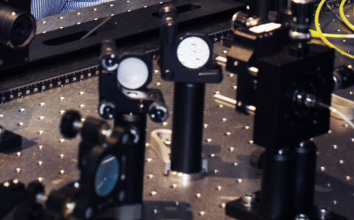
Past research: single-photon probes

This page describes experimental work carried out by the group in previous years. It is kept as a record and is not an active programme.
Can we probe and control the quantum mechanical properties of complex molecules?
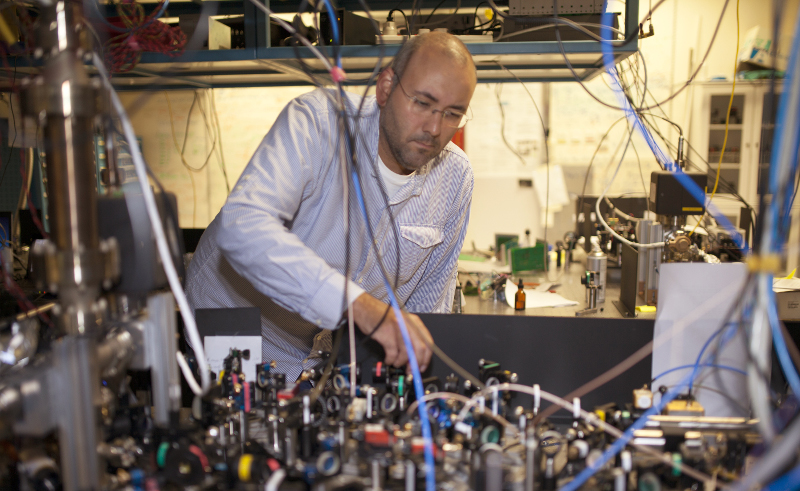
Background
A major goal of quantum physics is to use quantum mechanics to build efficient nanoscale information processors. This requires the control of quantum phenomena at the level of single electrons, where they behave as waves that extend over a region of space. The electron-waves, then, can combine and superpose constructively and destructively when their amplitudes are in step - this constant periodicity is called coherence and is necessary for quantum computing. A major obstacle to building such computers is that constant amplitude-relationships between electron-waves - and even within a single wave - are so short-lived that they don't allow time for computing operations. This is because heat from surroundings lengthens the electron-waves randomly and unequally. For this reason quantum experiments need temperatures as low as −272 °C.
A growing body of evidence suggests that protein-sized biomolecules could harbour long-lived quantum states. This is surprising given the large size and warm environments of the molecules, which are highly unfavourable to the extremely fragile quantum states. Ultimately we would like to copy their trick, which is a highly ambitious goal.
Aim
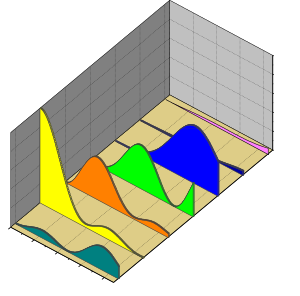
The ultimate and most sensitive way of probing complex systems is by using other quantum systems as probes. Our aim was to develop a state-of-the-art experimental quantum probe to test the properties of single molecules using single photons (quantum objects). By recording and analysing the statistical distributions of photons scattered by a single-molecule, we aimed to infer how well electron quantum states are confined or smeared inside the molecule, how efficiently the photons and electron states can encode information bits, and how much useful work can be extracted from them.
Our enabling technology was a highly efficient micron-sized optical microcavity (lens-system) that channels the extremely faint light signal when single photons are emitted.
The experimental effort covered quantum physics and chemistry, material sciences and molecular quantum optics.